

Evidence-based trauma therapy that works where talk therapy alone can’t reach. For adults carrying something that understanding alone hasn’t resolved.
Eye Movement Desensitisation and Reprocessing EMDR is a psychotherapy approach developed in the late 1980s and now one of the most researched trauma treatments in the world. It’s recommended by the World Health Organisation, the American Psychological Association, and the UK’s NICE guidelines.
The theory is straightforward. When something traumatic happens, the brain sometimes can’t finish processing it. The memory stays stored in a way that keeps the body reacting as if it’s still happening even when the person intellectually knows it’s over.
EMDR uses bilateral stimulation, usually guided eye movements, though sound and tapping may also be used, to help the brain reopen the memory and complete the processing it could not finish at the time. The memory does not disappear, but it stops feeling as if it is happening now. As that shift happens, the painful beliefs created by the experience can begin to change, and we work to strengthen newer, healthier beliefs about yourself and the world.

"What I love most about this work is witnessing the moment something shifts when a client suddenly sees their experience differently, and you can see the relief on their face."
- Susan Quinn Therapist, LMFT

We don’t begin trauma processing on day one. The first sessions are about building resources, establishing safety, and understanding the landscape. You need to feel grounded before we go anywhere difficult.

This is where EMDR is different. You hold the memory in mind while following bilateral stimulation. What comes up sensations, images, thoughts is processed set by set. You stay in the room. You stay in control.
Together we identify the specific memories, beliefs, or sensations that are the target of the work. We’re precise here vague processing tends to produce vague results.

Once processing has moved the charge on a memory, we work to install the more adaptive belief that naturally emerges. Each session ends with a return to stability never leaving you open or unsettled.

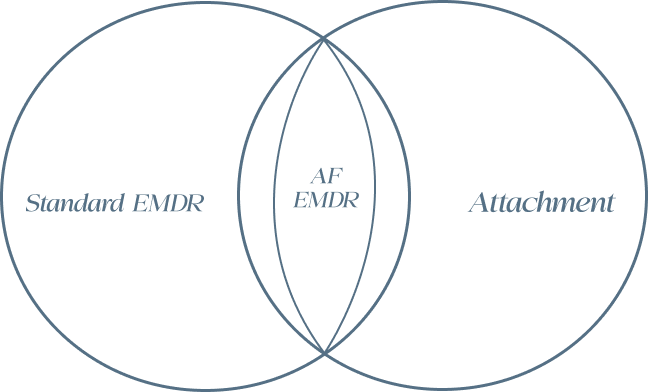
Standard EMDR processes specific traumatic memories. AF-EMDR keeps that work and adds a layer focused on relational wounds the early experiences that shaped your sense of self and your ability to connect with others. It’s the difference between treating a symptom and addressing its origin.
EMDR has been the centre of Susan’s practice since 2003. That’s not a selling point it’s just the work she found herself drawn back to, year after year, because of what it could do for people who’d already tried everything else.
She holds EMDRIA certification, the field’s highest independent standard for EMDR practice. She maintains active continuing education and consultation, as required by EMDRIA and as a personal commitment to the work.

Single-incident trauma (one specific event) usually resolves in 8–12 EMDR sessions. Complex PTSD, attachment wounds, and long-standing patterns typically take longer — three to nine months is common. EMDR works in a defined arc it’s not designed to be open-ended.
Yes. EMDR is recognised as a first-line treatment for PTSD by the American Psychological Association, the World Health Organisation, the U.S. Department of Veterans Affairs, and the Department of Defense. Over 30 randomised controlled trials support its efficacy for trauma.
No. One of EMDR’s distinguishing features is that you don’t have to verbalise traumatic memories in detail for the treatment to work. Your brain does the reprocessing internally. We talk about what comes up in your own time and language.
Trustindex verifies that the original source of the review is Google. Susan is an incredibly articulate and intuitive therapist who has supported me during various challenging periods in my life. Growing up in a home filled with violence and trauma, I have learned invaluable lessons about family dynamics from her. Susan has provided me with an extensive array of therapeutic techniques. Susan has introduced me to the principles of Cognitive Behavioral Therapy (CBT), Internal Family Systems (IFS) combined with Eye Movement Desensitization and Reprocessing (EMDR), as well as relaxation techniques involving breathing exercises. Inspired by her guidance, I have taken significant steps and pursued a career in mental health. I owe my progress and this journey to Susan’s support and the treatment plan she designed for me. Through a range of therapeutic approaches, she has significantly alleviated my anxiety and depression related to past trauma. Her patience and expertise are truly commendable. Susan excels as a therapist, demonstrating proficiency that surpasses the average practitioner. She is an authentic healer, a blessing in my life, who offers psychoeducation and bibliotherapy to enrich my treatment approach. Additionally, she stays informed about the latest treatment methods and possesses remarkable insight. Thank you, Marina Nicoletti Clinical Mental Health Counseling InternTrustindex verifies that the original source of the review is Google. Susan offers an incredibly warm and caring presence. I was initially unsure about EMDR and IFS as therapeutic approaches, but after just a couple sessions began noticing immediate progress in my relationship to self as well as others. I feel incredibly lucky to be arriving at breakthroughs in my life with her encouragement, and always look forward to our sessions.Trustindex verifies that the original source of the review is Google. Susan Quinn is a standout psychotherapist and life coach based in LA, whose expertise spans a remarkable array of therapeutic modalities. Her extensive training and certifications in EMDR, Neurolinguistic Programming, hypnosis, Ketamine-assisted therapy, Internal Family Systems, and the Emotional Freedom Technique reflect a deep commitment to offering diverse and effective treatment options. I was thoroughly impressed exploring Susan's website even before our conversation. Her ability to seamlessly navigate these methodologies to help clients move forward from life's challenges is truly exceptional. In her work with couples, Susan adopts a highly individualized approach, blending individual and joint sessions to tailor therapy to the unique needs of each relationship. This method not only fosters resilience but also cultivates a profound sense of safety and trust within partnerships. As someone deeply invested in trauma-focused therapy for parenting clients, Susan Quinn has earned my full recommendation. Her ability to integrate these varied techniques into a cohesive and impactful therapeutic journey makes her a valuable resource for anyone seeking profound healing and growth.Trustindex verifies that the original source of the review is Google. Susan and I have been colleagues for 15+ years, meeting regularly in peer consultation groups. She has always kept up with the latest therapy modalities and utilizes them in extremely creative ways according to each client's needs and strengths. It is notable that her orientation is toward results and that she consistently appears passionate about her work. I would highly recommend Susan Quinn to anyone who wishes to make life changes.Trustindex verifies that the original source of the review is Google. I came in suffering from emotional flooding after being in and out of a four year marriage that ended in divorce. I was overwhelmed in a darkness with tons of sadness that was taking over my life and I didn't know how to get out it by myself. My ex- husband has been through a lot of therapists throughout his life. Ironically, he's the one that found Susan for me to help me cope with so much sadness and emptiness. I literally cry throughout my first session. I am now in my fifth session and I am starting to see the light at the end of the tunnel. If you're feeling stuck and you're serious about moving forward, you can't do it by yourself. I truthfully recommend Susan. She uses different techniques throughtout the sessions as she reads and sees your needs. You will see her experience and professionalism within the first session. She's Awesome!Trustindex verifies that the original source of the review is Google. I found Susan at the recommendation of a highly intelligent mentor of mine who insisted that psychotherapy, with the right therapist, was instrumental to get over childhood trauma, an addiction problem, heal my psyche and develop the ability to live a successful, normal, happy life moving forward. She was right. When I first started working with Susan I lived here in Los Angeles’s Pacific Palisades neighborhood. I had become addicted to Marijuana as a self-medicating mechanism for depression, anxiety and as a coping mechanism for problems associated with a traumatic childhood. I was fraught with worry, fear, anxiety and in a lot pain. I had repressed my feeling to the point that it became impossible for me to label and articulate them, posing a road block to my recovery. Susan is completely different than any therapist I have ever worked with. I would go so far as to call her an intuitive healer. She is highly practical, empathetic, communicative and has the unique ability to speak directly with your subconscious. Susan worked for me and with me when other therapists have flat out failed. Susan introduced me to EFT and various other techniques that allowed me to safely recognize and address issues that have been troubling me for decades. When I first came to Susan, I couldn’t discuss aspects of my childhood without breaking down and had problems with addiction. She taught me coping mechanisms, used EFT, visualization exercises and language patterns to help me heal myself. She is not your average therapist. She is a gifted healer that teaches you how to heal yourself in combination with her therapy. After we started working together in person, I had to move to Miami because of my job. I had made great progress with Susan and did not want to stop with her thus we were able to continue our sessions via Skype. She is equally effective over Skype as she is in person. I am now sober, performing at the top level in my job, experiencing life changing decreases in anxiety, am balancing my psyche, have coping mechanisms I never expected and am able to function in a way I never though possible. Susan’s cutting edge therapy techniques were surprising to me as first and have changed my life for the better. I highly recommend her, especially if you have tried traditional therapies in the past that have failed. To say she is very good is an understatement. I’ve been working with Susan for about nine months now.Trustindex verifies that the original source of the review is Google. Working with Susan has truly been life changing. She is supportive, compassionate, knowledgeable, nonjudgemental, and professional. I feel comfortable talking to her about anything. The best part is that she provides me with resources that I can use outside of sessions. Such resources include tapping exercises to relieve stress or anxiety, youtube videos, book recommendations, and meditation links. She has truly helped me heal wounds, find confidence within myself and work toward leading the life I want to live.Trustindex verifies that the original source of the review is Google. Working with Susan has been life changing. I have been working with her consistently for months and she has helped me create real changes. I am happier and healthier and more confident than I've ever been. Thank you, Susan!
My office sits on San Vicente Boulevard in Brentwood minutes from Santa Monica, West LA, and Beverly Hills. For clients across California, telehealth makes the same work possible from home.
Primary office · 90049
20 min · Telehealth
20 min · In-person
20 min · Telehealth
20 min · Telehealth
20 min · Telehealth
No commitment, no paperwork. A chance to talk through what you’re carrying and see whether EMDR and whether I might be the right fit.